
Employee vs. Independent Contractor in Canada: How CRA Decides and What It Costs to Get It Wrong
If you’re a business owner in Milton, Brampton, Mississauga, or anywhere across the GTA, you’ve probably faced this question at some point: should I bring this person on as an employee or hire them as an independent contractor? It seems like a straightforward business decision, but CRA has strong opinions on the matter — and getting it wrong can be expensive.
Why This Classification Matters So Much
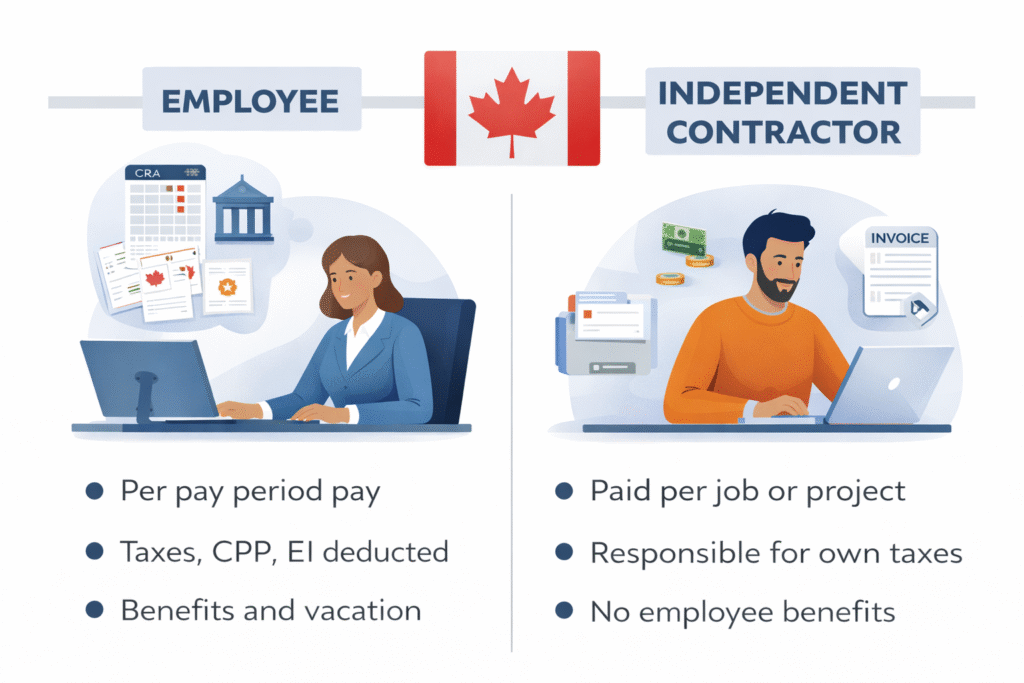
The difference between an employee and a contractor isn’t just about paperwork. When someone is classified as an employee, you’re responsible for deducting CPP contributions and EI premiums from their paycheque, matching the employer’s share, and remitting everything to CRA. You issue a T4 at year-end, and if they’re in Ontario, HST doesn’t apply to their compensation.
An independent contractor, on the other hand, invoices you for their services, handles their own CPP (through self-employment contributions), doesn’t participate in EI unless they opt in, and charges HST if they’re registered. The administrative burden on your end is lighter — but only if the classification is legitimate.
How CRA Actually Makes the Call
CRA doesn’t just take your word for it. They apply a multi-factor test to determine the true nature of a working relationship, regardless of what your contract says. The key factors include:
Control: Does your business control not just what the person does, but how and when they do it? The more control you exercise, the more likely CRA sees an employment relationship.
Tools and equipment: Who provides the tools? Employees typically use the employer’s equipment. Contractors usually bring their own.
Chance of profit and risk of loss: Can this person profit from good management of their work, or lose money if a job goes sideways? True contractors carry real financial risk. Employees generally don’t.
Integration: Is this person’s work integral to your business operations, or are they providing a distinct, specialized service? Someone who works exclusively for you, follows your schedule, and uses your systems looks a lot like an employee in CRA’s eyes.
Having a signed contractor agreement helps, but it’s not a shield. CRA looks at the actual working relationship, not just the label you’ve put on it.

What Happens If CRA Disagrees With You
This is where things get serious. If CRA audits your business and determines that someone you’ve been paying as a contractor is actually an employee, they can go back up to four years and reassess. That means you could owe all the CPP and EI you should have been remitting — both your share and the employee’s portion — plus interest and penalties on top of that. In some cases, CRA will pursue both the business and the worker.
For the worker, being retroactively reclassified as an employee can also create tax headaches, especially if they’ve been claiming business expenses or collecting HST that they weren’t entitled to. It creates problems on both sides of the relationship.
The Practical Takeaway for GTA Business Owners
Misclassification isn’t always intentional — many small business owners in Ontario genuinely don’t know where the line is. But CRA doesn’t distinguish between deliberate misclassification and honest mistakes when calculating what you owe. The risk is the same either way.
If you’re unsure how to classify someone you’re working with, or if you’ve been using contractors for years without reviewing the structure, it’s worth having a professional take a look before CRA does. A proactive review now is far less painful than a reassessment later.

At Syed CPA Professional Corporation, we work with business owners across Milton, Mississauga, Brampton, and the broader GTA to navigate exactly these kinds of payroll and compliance questions. We can help you review your contractor relationships, structure agreements properly, and stay on the right side of CRA’s rules.
Call Syed CPA at +1 (647) 977-8977 or visit syedcpa.ca