
If you’re running an incorporated business in Ontario, your T2 corporate tax return is your most powerful tool for keeping more of what you earn. But every year, we see corporations in Milton, Mississauga, and Brampton leaving thousands of dollars on the table by missing legitimate business expenses they’re entitled to claim.
The difference between a well-prepared T2 and a rushed one often comes down to knowing what qualifies as a deductible expense—and having the records to back it up. At the 12.2% small business tax rate on active income up to $500,000, every missed deduction directly impacts your bottom line. Miss $20,000 in eligible expenses, and you’re paying $2,440 more in tax than you need to.
Let’s walk through the 10 most commonly missed T2 business expenses Ontario corporations overlook, so you can make sure your next filing captures every dollar.

1. Capital Cost Allowance (CCA) on Business Assets
This is the single biggest deduction corporations miss. When your business purchases computers, furniture, equipment, vehicles, or even renovates its office space, those assets don’t get expensed all at once—they’re depreciated over time through Capital Cost Allowance.
Many business owners either forget to claim CCA entirely, or they miscategorize assets into the wrong CCA class, resulting in slower depreciation than they’re entitled to.
Key CCA classes Ontario corporations should know:
Class 10 (30%): Vehicles, vans, and trucks used for business
Class 10.1 (30%): Passenger vehicles costing over the prescribed limit ($37,000 for 2025)
Class 50 (55%): Computer hardware and systems software
Class 8 (20%): Office furniture, equipment, and fixtures
Class 12 (100%): Small tools, utensils, and medical instruments under $500
Class 14.1 (5%): Goodwill and other eligible capital property
The Accelerated Investment Incentive (AII) allows a larger first-year deduction on newly acquired assets, effectively giving you a 1.5x CCA claim in year one. If you purchased a $50,000 piece of equipment and didn’t apply AII, you could be missing out on thousands in additional first-year deductions.
Pro tip: Review your asset register every year. If equipment is obsolete or disposed of, you may be entitled to claim a terminal loss—a full write-off of the remaining undepreciated cost.
2. Home Office Expenses for Owner-Managers
If you’re a shareholder-manager running your corporation from home—even partially—your company can reimburse you or pay rent for the workspace. This is different from claiming home office expenses personally on a T1.
The corporate approach works like this: Your corporation pays you a reasonable amount for using your home as a business workspace. The payment is deductible to the corporation on the T2 and can be structured as tax-free income to you personally, provided the amount is reasonable and properly documented.
Expenses that qualify include a proportional share of:
- Rent or mortgage interest (not the principal)
- Property taxes
- Home insurance
- Utilities (heat, hydro, water)
- Internet service
- Maintenance and minor repairs
For a Milton homeowner using 200 square feet of a 2,000 square foot home as a dedicated office, that’s 10% of these costs. If your annual housing costs total $40,000, the corporation can deduct $4,000—and you receive that amount tax-free when structured as a reimbursement.
The mistake we see most often: Business owners either don’t claim this at all, or they try to claim it personally on a T1 instead of running it through the corporation where it provides more strategic value.
3. Vehicle Expenses and Mileage Reimbursements
Your corporation has two primary options for handling vehicle expenses, and choosing the wrong one—or worse, not claiming vehicle expenses at all—is remarkably common.
Option A: Corporate-Owned Vehicle
The corporation owns or leases the vehicle, deducts all operating expenses (fuel, insurance, maintenance, lease payments), and provides it to the shareholder-manager as a taxable standby charge and operating cost benefit on their T4.
Option B: Personal Vehicle with Corporate Reimbursement
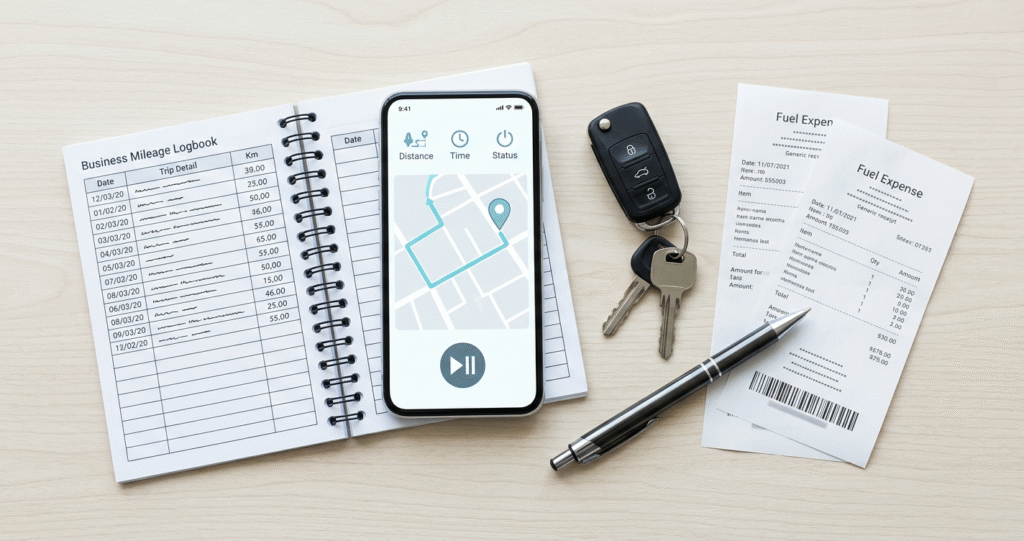
You own the vehicle personally, track business kilometers, and the corporation reimburses you at the CRA’s prescribed rate, 70 cents per km for the first 5,000 km and 64 cents thereafter in 2025. This reimbursement is tax-free to you and fully deductible to the corporation.
What gets missed: Many owner-managers drive extensively for business client meetings, site visits, bank appointments, supplier runs—but never submit mileage claims to their corporation. If you drive 15,000 business kilometers annually, that’s over $10,000 in deductible reimbursements your corporation should be claiming.
Critical requirement: You must maintain a contemporaneous mileage log. The CRA will deny the entire deduction without proper documentation showing dates, destinations, distances, and business purposes.
4. Bad Debt Write-Offs
If your corporation has invoiced clients who haven’t paid—and realistically won’t pay—you can write off those receivables as bad debts. This reduces your taxable income by the amount of the uncollectible invoice.
Requirements for a valid bad debt claim:
- The amount was previously included in income
- You’ve made reasonable efforts to collect
- The debt is genuinely uncollectible
- You’ve documented your collection attempts
Many Ontario corporations carry aging receivables on their books for years without ever writing them off. A client who owes you $8,000 from 18 months ago and isn’t responding to collection efforts? That’s an $8,000 deduction you’re missing.
Don’t forget the HST component. When you write off a bad debt that included HST, you can also recover the HST you previously remitted on that invoice by filing an adjustment. That’s an additional 13% you can reclaim.
5. Professional Development and Training
Investing in yourself and your employees is fully deductible, yet many corporations don’t claim these expenses—or don’t realize how broad the category is.
Deductible professional development includes:
- Industry conferences and seminars (registration, travel, accommodation)
- Online courses and certifications relevant to your business
- Professional designation maintenance fees
- Books, subscriptions, and trade publications
- Webinar platforms and learning management systems
- Employee training programs and workshops
- Coaching and mentorship fees related to business growth
If you attended a two-day conference in Toronto—$500 registration, $300 travel, $400 accommodation, and $150 in meals, that’s $1,275 in deductible expenses (meals at 50%). Send two employees to training programs annually, and you’re looking at thousands in missed deductions.
The key requirement: The training must be related to your current business activities. The CRA won’t allow deductions for courses unrelated to your industry, but the definition is broader than most business owners assume.
6. Health Spending Accounts and Employee Benefits
This is one of the most powerful and underused deductions for small corporations in Ontario. A Health Spending Account (HSA) allows your corporation to reimburse medical expenses—dental, vision, prescriptions, therapy, and more—as a tax-deductible business expense.
How it works:
- The corporation establishes a formal HSA plan
- Eligible medical expenses are submitted for reimbursement
- The corporation deducts the payments as a business expense on the T2
- The employee (including owner-managers) receives the benefit tax-free
For a corporation with one or two shareholder-employees, an HSA can cover:
- Dental work (cleanings, crowns, orthodontics)
- Vision care (glasses, contacts, laser eye surgery)
- Prescription medications
- Physiotherapy, massage therapy, chiropractic
- Mental health counseling
- Medical devices and equipment
If your family’s annual out-of-pocket medical expenses are $5,000, running them through a properly structured HSA saves you approximately $2,650 in combined corporate and personal tax—money that would otherwise come from after-tax personal dollars.
Important: The HSA must be formally established with a written plan document, and it must be available to a class of employees—not just the owner. However, if you’re the only employee, you qualify as a class of one. Consult your accountant to set this up correctly.
7. Management Fees and Salaries to Family Members
If your spouse, children, or other family members perform legitimate work for your corporation, paying them a reasonable salary or management fee is fully deductible on the T2.
Common roles family members can fill:
- Bookkeeping and administrative support
- Social media management and marketing
- Customer service and reception
- Inventory management and organization
- Cleaning and maintenance of business premises
The tax advantage is significant. Paying your spouse $30,000 for legitimate bookkeeping work shifts that income from the corporation (where it might eventually be taxed at higher personal rates when you withdraw it) to your spouse, who may be in a lower tax bracket.
CRA requirements to make this deduction stick:
- The work must actually be performed
- The compensation must be reasonable for the work done
- You should have a written employment agreement or contract
- Keep time records and job descriptions on file
- Issue proper T4 slips and remit payroll deductions
Red flag warning: The CRA actively scrutinizes payments to family members. Paying your teenager $80,000 annually for “administrative support” will trigger a review. Be reasonable, document everything, and ensure the work is genuinely being done.
8. Website, Software, and Digital Subscriptions
In 2025, nearly every business relies on digital tools, yet many corporations lump these costs into vague categories or forget to claim them entirely.
Commonly missed digital expenses:
- Website hosting and domain registration
- Website design and development (or amortized if capitalized)
- Cloud storage (Google Workspace, Microsoft 365, Dropbox)
- Accounting software (QuickBooks, Xero, FreshBooks)
- CRM platforms (HubSpot, Salesforce, Zoho)
- Project management tools (Asana, Monday.com, Trello)
- Email marketing platforms (Mailchimp, Constant Contact)
- Social media scheduling tools (Hootsuite, Buffer)
- Cybersecurity software and VPN services
- Industry-specific software and licensing fees
A typical Ontario small business might spend $3,000-$8,000 annually on software subscriptions alone. If you’re not tracking and claiming each one, you’re overpaying on taxes.
Important distinction: Monthly subscription fees are fully deductible in the year incurred. However, if you pay for custom software development exceeding $500, you may need to capitalize it as a Class 12 or Class 14.1 asset and claim CCA over time. Your accountant can advise on the correct treatment.
9. Bank Fees, Merchant Fees, and Loan Interest
These are the expenses hiding in plain sight. Every corporation has them, but many don’t track them as deductible business expenses.
What qualifies:
- Monthly business bank account fees
- Wire transfer and international transaction fees
- Credit card processing and merchant fees (Stripe, Square, Shopify Payments)
- Interac and debit transaction fees
- Business loan interest (operating lines, term loans)
- Credit card interest on business purchases
- Mortgage interest on business-owned property
- Equipment financing interest
- CRA instalment interest (in some circumstances)
For corporations that process significant credit card transactions, merchant processing fees alone can total $5,000-$15,000 annually. A restaurant in Brampton processing $500,000 in card payments at 2.5% is paying $12,500 in merchant fees—every dollar of which is deductible.
The overlooked detail: If you used a personal credit card for business purchases, the interest on those charges is still deductible to the corporation if the expense was genuinely business-related and the corporation reimburses you. Keep clear records separating business from personal charges.
10. Year-End Bonuses and Accrued Liabilities
This is a strategic deduction that most small corporations miss entirely. If your fiscal year-end is approaching and your corporation has earned more than expected, declaring a bonus to yourself (or employees) creates an immediate deduction on the T2—even if the bonus isn’t paid until up to 180 days after year-end.
How it works:
- Your corporation’s fiscal year ends December 31
- On December 31, the board of directors declares a $40,000 bonus to the shareholder-manager
- The corporation deducts $40,000 on the T2, reducing corporate taxable income
- The bonus must be paid by June 29 of the following year (within 180 days)
- When paid, the corporation withholds payroll deductions and issues a T4
Why this matters: Without the bonus, the $40,000 sits in the corporation and gets taxed at the corporate rate. The bonus converts it to employment income taxed at your personal marginal rate—which may be lower if you’ve managed your other income sources. More importantly, the bonus creates RRSP contribution room.
Other accrued liabilities commonly missed:
- Accrued vacation pay for employees
- Outstanding professional fees (accounting, legal) incurred before year-end
- Property tax accruals
- Utility expenses incurred but not yet billed
- Warranty reserves for product-based businesses
- Bonus: The Expenses the CRA Will Challenge
While you should claim every legitimate deduction, certain expenses attract CRA scrutiny. Knowing the boundaries helps you claim confidently.
Proceed with caution on:
- Meals and entertainment (only 50% deductible—always document who attended and the business purpose)
- Club memberships (golf, fitness—generally not deductible unless directly related to earning income)
- Clothing (only deductible if it’s a uniform or protective equipment, not regular business attire)
- Personal portions of mixed-use expenses (always apply a reasonable business-use percentage)
The golden rule: If you can’t prove it’s a business expense with documentation, don’t claim it. But if you can prove it? Claim every single dollar.

Your T2 Deduction Action Plan for 2025
Here’s what every Ontario corporation should do this year:
- Conduct an expense audit — Review the last two fiscal years for missed deductions. You can refile amended T2 returns to claim expenses you missed previously.
- Set up a proper chart of accounts — Your bookkeeping software should have specific categories for each deduction type listed above.
- Establish an HSA — If you haven’t already, set up a Health Spending Account before your next fiscal year-end.
- Start a mileage log — Today. Not next week. The CRA requires contemporaneous records.
- Review your CCA schedule — Ensure all assets are properly classified and you’re claiming the accelerated first-year deduction where applicable.
- Pay family members properly — If family members work in the business, formalize the arrangement with contracts and reasonable compensation.
- Talk to your accountant — A year-end planning meeting can identify opportunities you’d otherwise miss. The cost of this meeting is itself a deductible expense.
The reality is this: the difference between an average T2 filing and an optimized one is often $5,000-$15,000 in additional deductions for a typical Ontario small business. Over five years, that’s $25,000-$75,000 in expenses you could have claimed—translating to $3,000-$9,000 in tax savings at the small business rate.
Don’t leave that money with the CRA.
Have questions about your T2 deductions or want a review of your current corporate expenses? Call Syed CPA Professional Corporation at +1 (647) 977-8977 or visit syedcpa.ca for a free consultation.
— The Team at Syed CPA